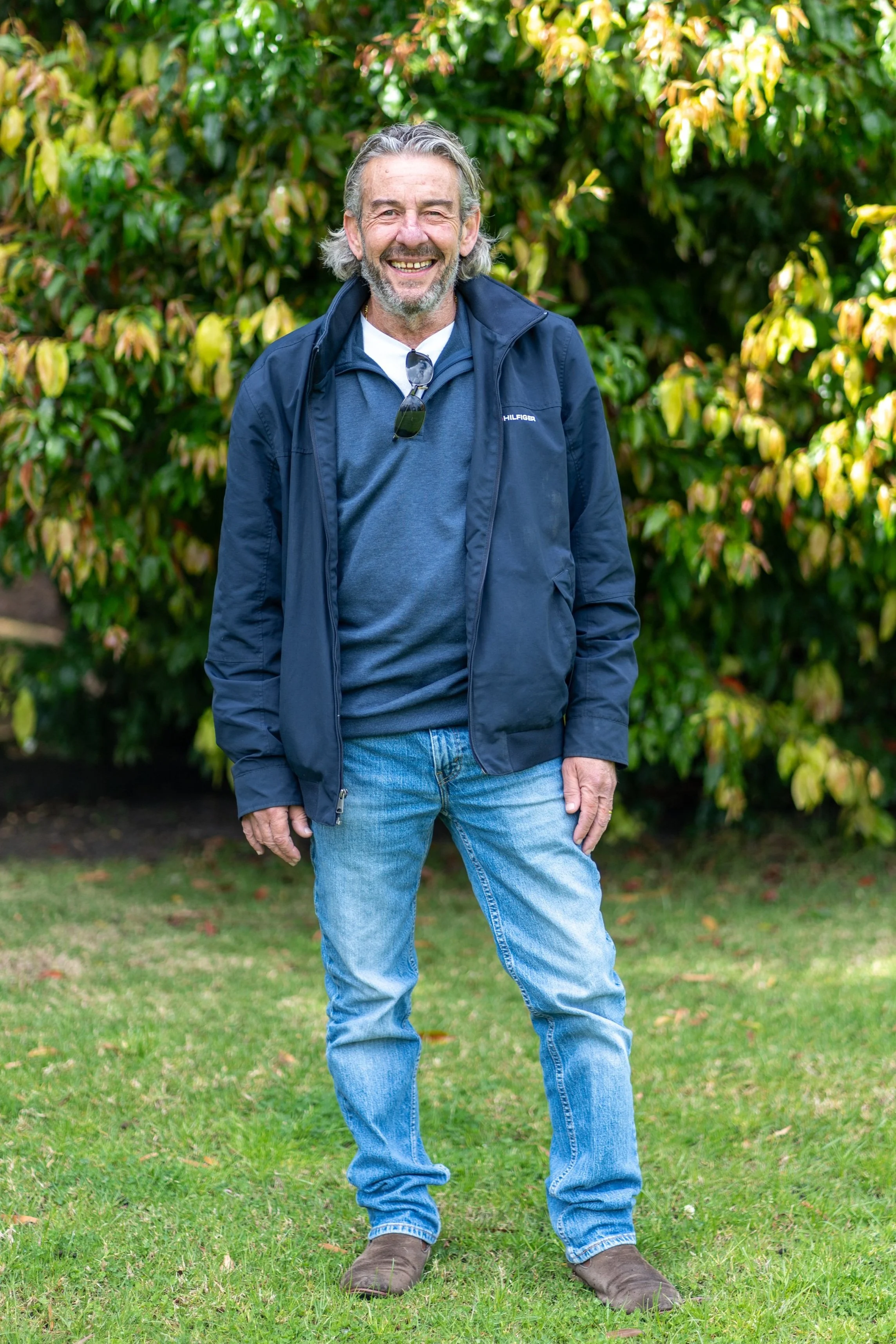
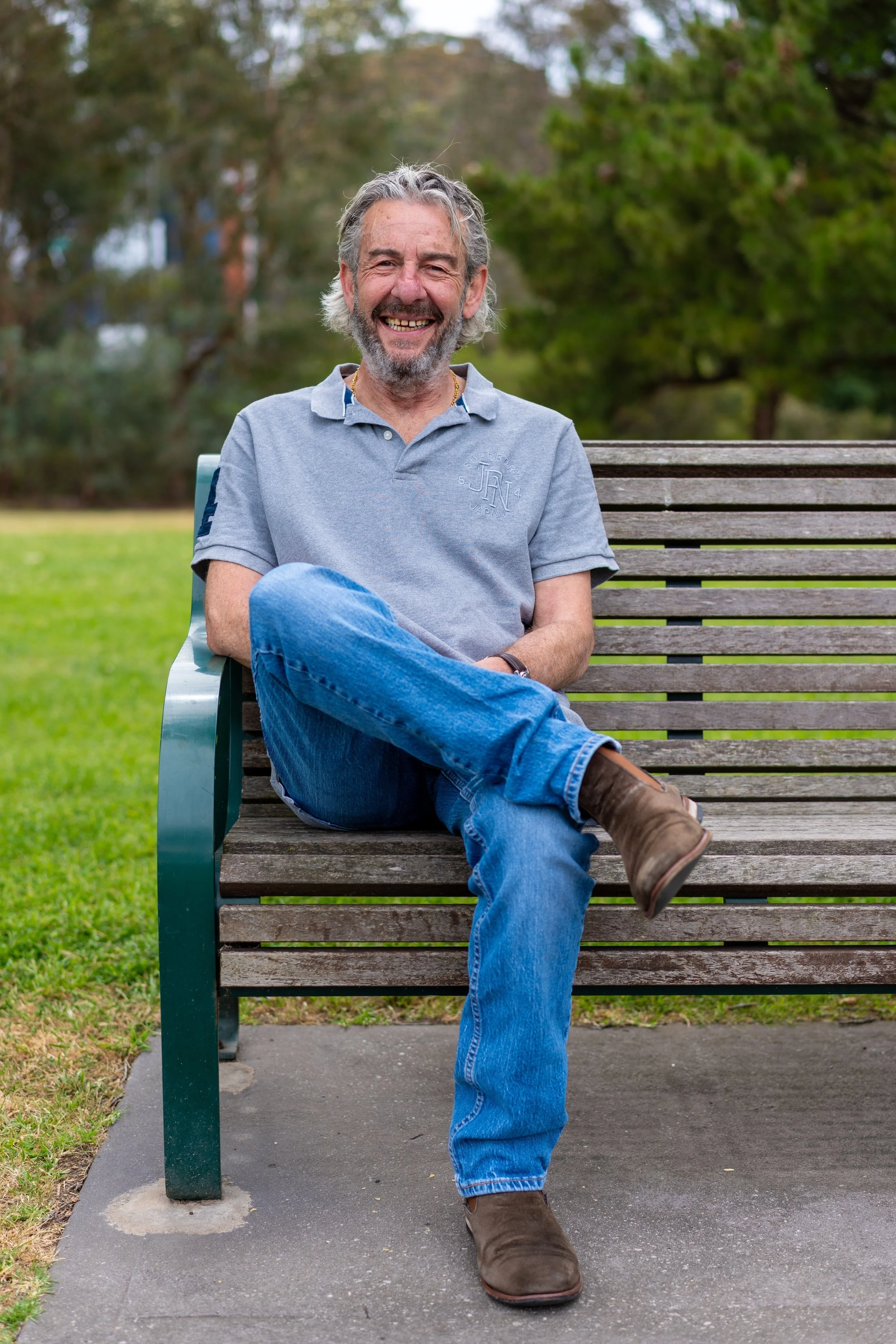
This interview took place at the Fitzroy Gardens in East Melbourne, Melbourne, Australia, on the 15th of September, 2024.
Ahmed: Would you mind introducing yourself?
Danny: Hi, my name is Danny. I'm 61 (years old), Melbourne born and bred.
Ahmed: What do you do for work?
Danny: For the last 37 years or so I've been in, in the jewellery and watch game – selling, repairing,
and anything else to do with it. Jewellery, watches, clocks - Anything that ticks and moves.
Ahmed: 37 years, so that must have been…
Danny: 1988 is when I started.
Ahmed: So, do you remember where you started?
Danny: Swann Street, Richmond. I worked for the Commonwealth Bank before that and my father turned around to me and said, “Come and learn a trade, it will do you good”. And I was going nowhere at the bank. I thought this is as good chance as any.
So, Dad and I started the shop in Swan Street in September of 1988, together.
Of course, he'd had 25 to 30 years of experience already, he taught me everything he knew. I started at the bottom. And when I say at the bottom, I'm at the bottom and learnt as I went along.
I think Dad retired in about 1995. I'd love to say that he gave me the shop. But he didn't. Because I have two brothers, I have to pay for it.
It was dad’s. And, it would have had to be split three ways, had something happen to him he basically said “if you want it for yourself, you gotta pay for it”.
So that took about five years to pay him off, for the business, every week, I'd send him money and then it was mine.
Ahmed: So that was maybe around early 2000?
Danny: That's exactly what it was. I think I finished paying for it in about 2001, something like that.
Ahmed: So, that was his trade before you?
Danny: Yes. Yeah, he had. He had a couple of shops out in Coburg, previously, with a partner.
And when him and his partner split, he decided “Well, right, I'm going to do it for myself.”.
He looked for somewhere to do it. It was a shop in Swan Street, which at the time was a very good shopping area, it doesn’t look like what it is now.
So, we started there, and then 35 years later I left.
Ahmed: If you can describe your journey, you've told me it's a big part of it, but your journey from then till now doing that job, how would you take me through that?
Danny: Well, look, as you know, as with anything that you do, it's a learning curve and you make mistakes. The most important thing is that you learn from your mistakes.
When I was learning to do repairs and things like that, I wasn't trusted to do customers work. I was trusted to do, let's just say, ‘crap’ that was lying around in the store. And dad would say “This is how you can fix this, and I'll show you how to do it”
I would go ahead and do it, then, then I would ‘bugger it up’ any number of times before I got it right.
And he said “You can ask me any questions, no problem. But once I give you the answer, I expect you to remember. Don't come and ask me five times the same thing, commit it to memory, when I show you something or when I teach you something.”
So, I wouldn't say that I was perfect student. But I wasn't bad.
He used to send me into the city to liaise with suppliers and things like that, so I would get to know them, and I would get to know the area and get to know what I was looking for.
And so yeah, I started at the bottom and worked learnt the business until I was able to take it over.
Dad was very very hard.
Ahmed: In what sense?
Danny: In every sense. He was a very good businessman. He taught me that practically anybody can learn how to sell. Where you make your money is in your buying.
When somebody's buying the same item for $70 and you're buying it for $50, you can sell it cheaper than what they can sell.
So, it's not necessarily how would you sell, it's how could you buy!
Ahmed: Interesting – I don’t think I've heard that before. It's very smart.
Danny: But even since it's true, it doesn't matter if somebody paid 70, and you paid 50, and you can't sell, it doesn't make any difference. But he taught me how to sell, he taught me how he reacted with customers, how he approached customers, and I learnt.
Ahmed: Was he a good teacher?
Danny: He was a ‘Do as I say, not as I Do’ sort of guy.
But Dad was a very good operator, and I could have learned from a lot worse than him.
He was successful and I was more than happy to follow in his footsteps and learn from him. Of course, he taught me everything he knew, and I learned a hell of a lot more than what he ever did over the journey. Things change; you know. The style of watch has changed in that time. Jewellery became a lot more fancy. and different ways of doing things became apparent over the years. And dad was too old, and he wasn't interested anymore as I had to learn new ways.
It was as much as my father and I butted heads, and we butted heads a lot, right through my teenage years to… Even when we worked in the shop together, we had plenty of times where we didn't see eye to eye.
There is a number of times where I pack up my shit and just storm out of the shop in the middle of the afternoon. And he’d meet me at night, and he would say ‘are you coming back tomorrow?’, I would say ‘Yeah, I am coming back tomorrow, but I couldn't stand being around you anymore today.’ He’d say “Well, you did a good thing getting out because otherwise I would have killed you today.”
I respected him. I always did. But we didn't always get along.
I might have fractured a few rules on my way through. And I'm only talking about at home and stuff like that, but not work.
Ahmed: So, looking back, since 88 until now, what would you say are your favourite things about your job?
Danny: To do different things, challenging things.
Once you learn how to do things. basically, the basics, it becomes like everything else. It becomes routine and monotonous. To change a battery is a routine thing - it's monotonous. But to make rings, difficult repairs, …. Those are the things that excited me over the journey.
There's a lot of monotony, but there's a lot of different things, and the challenge to do different things to make different things, to repair difficult things, that's where I got my biggest kick from.
Ahmed: What did you enjoy the least about your job?
Danny: (Laughs) In no particular order: The monotony of turning up to the same place six days a week for so many years. Staff, there was always issues. And customers. Not every customer is a nice friendly person. Some customers were not.
And, the one thing that I've picked up for sure from my father was the short fuse with bad customers.
You get some terrible people and they’re of the opinion that you're just here to provide a service. They won't answer me back.
I was never rude to anybody first, but if you were rude to me or my staff, I was 10 times ruder back.
If that's the type of people that customers were like that, I didn't want them.
But for the most part, things were good there. I’ve built up a massive clientele over the years, as you would expect after 35 years.
And as you can tell by the Facebook site, my reputation was and is still pretty good.
And I protect it fiercely. And I try not to do anything that will jeopardise that.
Ahmed: What about the most difficult part of the job? Or a type of job that was stood out very early as very difficult, like when a customer comes in and asks for it, you're like ‘It's going to be one of those days where I have to stay late or spend 4 hours doing something that is very complex or something of that nature’?
Danny: Spending four hours doing something complex is something I enjoyed.
There's a great sense of satisfaction and accomplishment when you do something like that.
There's very little sense of accomplishment when you do the easier things, because I can do it. The next jeweller down the road can do it. Anyone can do it.
It’s the things that not everybody can do that excited me. But you've got to be able to do the basic things well as well.
Ahmed: And fast
Danny: Well, my turn-around was generally within the week, and it still is, for the most part.
Ahmed: What is something that most people don't realise about your job?
Danny: The difficulty and care that it takes, and the time that it takes to do things, and the time that it takes…
See, especially in watches, a lot of the time, you are relying on suppliers and other people for parts and things like that.
Sometimes they're not readily available. People not necessarily always understand that.
I (also) found that when I was in the shop that I would have to do the major work I at home at night.
Because when you're working with small parts or you're doing intricate work, you can't stop and start all the time. When customer comes in, or when somebody wants something….
You need to be able to spend time sitting there doing it and concentrating on what you're doing.
So, not only was the job, you know, eight to ten hours in the shop, at night, but it was often two to three to four hours of work at night afterwards.
And weekends, you know, the work has to get done sometime.
And when you try to have a little bit of a life other, a young family,….
Something always has to give.
Ahmed: What is something that a lot of people misunderstand about your job?
Danny: Certainly, the cost involved. People think, you know, this is a five minute job!
What are you talking about? Well, it's not.
It's often not a 5-minute job. That would have been the main thing.
People don’t understand the costs involved in running the shop, the rent, the electricity, the phone, the staff, the superannuation, the maintenance of the shop.
And all that sort of stuff.
It's all part of the cost of running a business, and all of that had to get back into the price of doing things.
That's the beauty of doing it by myself from home now, without those overheads, everybody gets it cheaper so.
Ahmed: So tell me about the journey that led you to decide close the shop?
Danny: That’s easy. The shop was literally falling apart.
When I say literally, I mean literally.
The floor in the shop had completely gone so.
I used to have a big tile at the front door to stop people from putting their foot into a hole at the front door.
My safes were literally tipping out of the cabinetry work.
It was only the cabinetry that was holding the safes in place, otherwise they would have tipped over.
So, the floor had to be redone.
I was just getting new owners again [as] It's not my property.
So the owners said they would, do the floor for me - not a problem.
But I would have to have removed all the cabinetry work, all the fixed cabinetry work, the safes, desks, everything that had to come out, so they could redo the floor.
I would have had to pay to put all the cabinetry work back in.
New display cabinets, putting the safes and everything back, in new stock because it was, six months after COVID had finished.
I figured it was gonna cost me somewhere between three and five hundred thousand dollars to do all that work.
I was nearly 60.
I knew that we were going into a recession, no matter what the government says, no matter what the actual official figures say - we've been in a recession for a year and a half.
I would have had to sign a new lease.
I'll never see that money.
I will never see that sort of money.
How much longer? I'm gonna stay? Five years! Three years!
That that money I would never get back. It's not my property.
I don't wanna put that money into somebody else's property.
It's time to leave. It's time to move.
So, I thought, well, what can I do?
Well, I thought, this is what I'm good at, this is what I enjoy.
I'll put it on my Facebook site. I'll give my number to a whole lot of my old customers.
And also what it's like – if it one day a week, one day a fortnight, I’ll come into Richmond and do a few jobs.
As it's turned out, it's been way, way, way busier than that.
So it's keeping me more occupied than what I thought I would ever be again and I enjoy it.
So that's what brought led me to closing the shop.
If the floor would have stayed intact and everything would have run as normal I would have probably still be there.
But I'm glad I'm not.
The beauty is now I can have holidays.
That was one of the huge drawbacks of being in the shop that there were no holidays.
It was 10 days over Christmas, you know, and public holidays!
And that was it.
Now we go two to three times a year for 2-3 weeks at a time and I have a life now.
Ahmed: So, speaking of retirement, how long would you like to keep doing what you're doing?
Danny: Till I can't anymore. It's something that I enjoy doing.
It still allows me plenty of time for myself, if I want.
I still enjoy the contact with people.
I've always enjoyed the contact with people, even when I'm not in the mood for it.
I still enjoy the contact with the people, because being in contact with nice people, whatever brightens my mood.
And I really don't come across people I don't want to see anymore.
Whereas in the shop there was all those people that came in that rubbed you the wrong way in one way or the other.
Whereas the people who contact me now, do not waste my time, and actually want the service from me. I'm more than happy with that.
Ahmed: What would you say are your most proud of?
Danny: Proud of my family, my kids. That's what I'm most proud of.
That my kids have turned out to be good people.
Listen, you see kids on drugs and kids walking the streets in the middle of the night and what have you.
They were not perfect, but I've had very few issues with my kids and that's what my wife and I are proud of is how our kids have turned out.
Ahmed: What about what you're most proud of your regarding your job and career?
Danny: The fact that I was able to make a success of it over all those years.
I've always said that the business was never going to make be a multimillionaire, but I would never go hungry.
And both turned out to be true.
I'm no multimillionaire, but I've never wanted or I've never said “Oh, no we can't afford that or we can't afford to eat or we can't afford to go here or whatever”.
That's not an issue.
Ahmed: And that is in and of itself is a great achievement. A lot of businesses come and go.
Danny: That's right. And the fact that I was able to learn and make it a success over a long period of time.
Yeah, I'm very proud of that.
Ahmed: Any strange coincidences or someone coming in with jewellery that you thought “oh, this looks familiar” or a celebrity coming in or…?
Danny: I had people come to try and sell me jewellery that they had stolen from me.
As they’ve come to try and sell it to me, I’ve noticed that it was mine, and I’d say:
“Thanks. I'll keep that. That was mine. Should we call the police down now?” “No, it's alright.”
Ahmed: Celebrities?
Danny: Well, it depends on your definition of celebrities, but I had a lot of footballers, cricketers, some athletes that used to try down, Olympic Park down there, or Gosch’s paddock.
In the old days when the greyhounds used to run around the Olympic Park, I used to have some greyhound people who used to come in.
I sold Max Gawn a wedding ring. I saw I did repairs for Isaac Smith, Brendan Gale, …
Molly Meldrum was a very good customer of mine.
Being in Richmond, there was always footballers and other celebrities.
Ahmed: Before we wrap, is there anything else you'd like to share?
Danny: Thank you for being interested enough in my average to mumbling stories.
It's a life like most of other people, I think.
You work hard for your wife and your family, and to build something for yourself and, fortunately for me, it worked out well and you know…
I'm in a reasonably good position for a bloke in his sixties….
Ahmed: That, in and of itself, is a great achievement.
Danny: Well, you know, I wish it for everybody.
It's unfortunately not the case for everyone.
But, if you work hard, you deserve to get an even break.